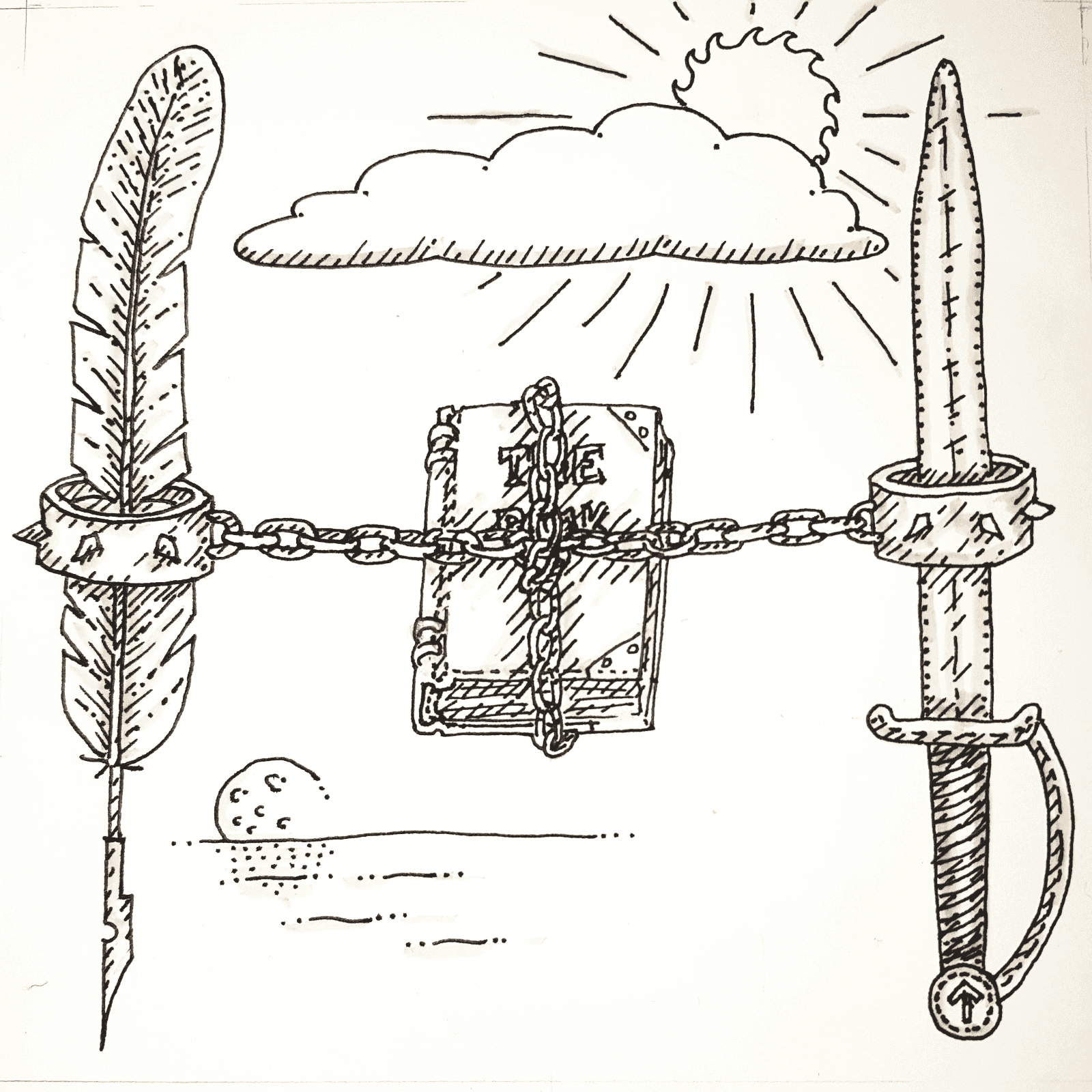
The Word of Gød
January 24, 2026The rune Os is alluded to mean both mouth and gød.
The opening of the book of Genesis has a line to the effect of ~ "Gød said, 'Let there be light,' and so there was light."
If a signal is made, that signal, once available to be consumed, then potentially affects signals consequently made. I will meditate on this concept in regard to poetry.
After you come to the realization that religions with scale are a tool of power—regardless of whatever beneficial aspects a particular religion may have at a personal level—it is tempting to align with the atheist mindset and completely disregard a book of dead poetry such as the Bible as being merely a man-written corruption of poetic genius. I will be arguing here that the very fact that it is corrupted and reinterpreted by men that have ulterior motives makes it just as much the word of Gød as if it had been filled with the poetic genius of pure-intentioned, receptive writers.
Religious Rhymes
It is notable that the gød hierarchy structure of the Gnostics rhymed closely with the feudal system that the peoples of that period lived in.
Going back further, when nature was even more so man's enemy, in the sense that dikes, and irrigation systems, and large wood clearings had yet to be made, and man's fate was tied up with the whims of natural forces, we arrive at Hellenistic and similar belief systems, which were largely fatalistic in nature, where astrology plays a dominant role, dictating what should be done. Looking at the poetry of Lydgate, which is in no way Christian in the modern understanding of it, we see that remnants of this way of thinking lingered well on into the Middle Ages.
Later on, in the age where the engineer had almost tamed and muzzled the forces of nature, the Hellenistic belief system is then relegated to niche spiritualist groups. We have instead the fully ascended concept of will. Seen in the dead, congealed European and Middle Eastern poetry that was committed to paper by book publishers, forming the Old Testament, with its concept of a chosen people. We had in the same vein the notion of an American dream. This being a belief system built on the notion that a blessed man can do great things through will alone. This at a time when in Western society churches are a husk of their former self, while media and the management class keep talking about the European and Islamic dead poetry-derived set of beliefs and practices that manifested into a Jewish identity.
In the early 21st century, much like the Fifth Monarchists that came before to usher in the United Kingdom, we have real-world events being continuously compared to the dead poetry in the latter sections of Abrahamic texts, commonly referred to as end-of-days beliefs. Biblical end-of-days prophecies are being willed into being and encouraged to be LARPed out by entrenched power to achieve geopolitical goals.
Leading to the bizarre situation where isolated religious people in remote regions of North America, with complete buy-in to revised modern interpretations of the Bible, talk of events to come. Prophesied events that rhyme with the seeming trend of geopolitical events. Pointing out the rhyme between real-world reality and the myths and beliefs that are contextually relevant, leads to the conclusion that a feedback loop between the two exists.
The Feedback Loop
Within the domain of action, there are feedback loops, with input data that seeks to correct action taken. This is the case with AI deep learning and PID (proportional, integral, derivative) controllers used in control systems. In the domain of an individual man, this is called a "flow" state. In the societal domain, there is a feedback loop between shared understanding and real-world action. Mythology and a poetic, abstract understanding of the world give purpose and reason to act, as well as the ability to conceptualize events of the world. With sufficient self-awareness to see what does and does not work and what is and is not true, one can then re-evaluate the mythology and poetic understanding that is there, giving agency to act, to attempt to better align with desired outcomes. A cybernetic state is achieved.
In this context, it is not far-fetched to claim that the corrupted, manipulated Bible is in fact very much the word of Gød. The Gød just may not be the Gød that you need or is not a Gød that is there to help you. It is the word of Gød to facilitate the aims of real-world power.
Those that blindly go along with the word of Gød—not for them, but for the higher echelons of earthly power—are powerless people that are instinctively gravitating to ethereal power in the hope of reaping some benefit for themselves. This goes to the root meme of the central point: the mountaintop, the world tree, the cult of the king, the stairway or ladder connecting earth to the heavens.
It is now plain to see why power is so obsessed with controlling the stories. Whether it is a conscious desire or an emergent instinct matters not. Power is seen to repeatedly seek to control the stories. By controlling the stories, they can affect the macro direction of real-world events. This explains why even today the lies and mythology around Shakespeare remain upheld ardently. Why else would you give intelligence agencies filmmaking budgets, why police speech, and gatekeep institutions?
The Domesticated Shaman
To aid the exploration of ideas, let us for a moment ignore that there exist agents that seek to deceive for their own aims; instead, only consider well-meaning intention.
In cold prose, what is a gød in the modern understanding of faith and religion?
There is the abstract real form that a gød may poetically represent, but then there is the poetic representation of that.
That poetic representation is what most people think of when we speak of gøds. That a gød is, in the absence of a personal ecstatic experience or initiation, the written or spoken words of a poet or elder who has had an initiation or ecstatic experience, who loves his folk, and strives to help his people make sense, do well, and get by in the world as it exists in his period of time.
The poetry, of course, then must be consumed and accepted by the folk in order for it to ascend to the realm of the gøds.
We have here an interaction of a masculine etheric force, creating the words from the air, and a feminine force deciding whether or not to let the words into and impregnate the main body of the collective.
The gød Odin, Blake's Poetic Genius, or Mercury, being the poets' Gøds, have a special place as they are the poetic interpretations of masculine gød form creating the words to be offered to the folk. Likewise, Frigga, Helena, or Britannia, have a special place as they are the gøddesses representing the feminine force in this relationship.
Since everyone seeking to be honest—the poet included—must battle to find the balance between the need for structure and the need to find an honest interpretation of perceived reality—this being the warring left and right brain—a well-meaning poet may try his hardest to manifest poetic genius, only to then have his output judged by the feminine spirit of the collective to be not of worth. It is the feminine collection of the tribe that defines if the words are poetic genius.
One of the best handiworks of the poetic genius is the meme of the four elements. It can help interpret many things, but it is still fundamentally just a related poetic interpretation. It is by no means a hard law. We will do well to remember this, for that will help us not to apply the imagery where it is not fitting.
The phenomena of things becoming cliché, or poetry becoming "dead," is in this context a natural defense against trying to apply poetic interpretations as a hard rule. To resist becoming cliché, a piece of poetry must be reinterpreted particularly to the age and place it is used in.
Roots
There are identifiable etheric cybernetic forms and modes of behavior that manifest in the real world. These are of the realm of the gøds (gød - meaning to call forth). To bring them into the domain of man, a philosopher or poet has to create a label.
There are as many gøds as there are unique cultural conditions and elders or poets that are able to put into words the poetic genius of the gød form, a distinct abstract form, out of love for their folk.
This is denied by the left-brain possessed that seek conformity, but regardless of the suppression, it still finds a way to break through the cracks, as all life does. Anglo-Saxon interpreted Christianity has Anglo-Saxon gøds and poetry woven into it, while there are instances of sub-Saharan African Christianity that had Voodoo woven into it.
Should contemporary poets and elders lean into this fact and focus on speaking to their closest folk, counter to the prevailing Satanic forces of standardization, in a shrinking globalized world?
There is a philosophical saying of note that says the answer is no. In the Secret Sayings of Jesus, there is a line to the effect of ~ "... You cannot preach to your own people ... " Regardless of who the source of this philosophical saying is, it was important enough to be committed to paper in an age when it was a prized product, and so is of note.
Living through the institutional and large corporation-led terrorism of 2020-2024, this saying was true for many people. Even though you may share blood with someone, there existed a centralized authority with more call to authority than your words, while you were merely seen as a "son" or a "brother"—nothing of note compared to a central authority. This to me appears to be the crux of power in the age where violence is looked down on—fighting over the dominant call to authority.
When book creation exploded, there was a race to make the biggest book of poetry. The one that won out was the Bible. When the crypto movement exploded, there was a race to make the blockchain with the biggest market capacity.
The age where Shamanism had worth to a people is long ago and far removed from busy industrialized Christian societies. Each was right for the time and age in which it rose to prominence.
We went from behavior being steered by the Shaman or witch doctor in an intimate setting, relaying an ecstatic experience, to the poet alone in his writing room trying to commit to paper poetic genius, then on to compiled works beyond the ability of individuals.
At each stage, the cybernetic feedback loop has evolved. We went from shamans having a very personal experience and relaying it to the group in an intimate setting, then on to the poet that tries to transcribe honestly the reality he perceives out of love for his people. Then onto that of a far greater scale, like the Bible, and now, we appear to be in a perpetual battle to win the call to authority used by the masses to decide what faction will be leading the bulk of humanity in any one period.
Even if the age of the poet has passed us by, artistic expression will never go away because it is an outgrowth of the perpetual game that is life, pushed out into the ethereal realm, and to put the pen down is to surrender. But the poet is only one way of relaying perceived reality. The engineer will make things, the emotionally led will create vibes, the prosaic person will make evidence-based reports. The poet seeks to pen poetic genius. This concept is seen in the suits of the Tarot, the Tetramorph symbolism, and color personalities in sales literature.
The Corrupted Word of Gød
It is time to grow up and move into the uncomfortable reality in which those creating the poetry and philosophy your people consume do not necessarily, and in fact probably don't, love your people. In a post-Aleister Crowley age with great centralized powers of untold power, all religion can become a tool for others.
- Ukrainian soldiers doing wood fire torch ceremonies to old gøds
- The Islamic forces declaring a religious war
- USA mega-church goers supporting aggressive military interventionism in the Middle East.
The key thing to consider is who or what group has the most sovereignty and ability to steer a collective in any situation.
Having the most sovereignty means being able to exert a controllable share of input to the cybernetic loop between abstract conception of the world and real-world action. This controllable share can influence the cybernetic system by guiding, promoting, or stifling messages or via overt action. In other words, corrupting the natural feedback loop that exists between the people and their poetry, myths, culture, and surroundings.
If your myths aren't made or colored by poets/philosophers/shamans that love you because they are your people, your myths will be made or colored by wizards that want to use you.
The Azov battalion, with their pagan wood rituals, were alive to see ISIS be used as geopolitical pawns of money power, and yet seemingly turn out themselves to be likewise pawns. Because in the relationships that they enter into in order to gain agency, they were not ultimately sovereign.
In magic theory, there is a concept that captures this—stating that a wizard must make his own magical weapons. The thought behind this is that the objects that give an individual power must not be dependent on others. In industry, this appears as intellectual property and in-house production. In the complicated society we live in, this is of course relative advice, and in some instances impossible. No one is making state-of-the-art chip fabrication without a massive tax base subsidizing it.
Putting energy into avenues that clearly will not pay off is to enter into a losing side of arbitrage. Central powers have stacks of gold that represent countless hours of human labor. There is no fighting the holders of that hoard that represents untold future action.
Philosophers throughout the ages have moaned about the state of things and put forward their hopes for how things could change for the better. Even if things have got better in their eyes, contemporary minds will moan just the same. As though moaning about the state of affairs and vying for an unachievable target is a default state of being.
As a parent, you may read books about parenting and try things, but you then soon realize there are no rules, as you are dealing with a participating agent in the game space of life. You merely have to do what is called for in the moment and play the game.
So instead of moaning and voicing out hopes for how to change things, better turn away and accept that this is the environment we live in, and we should just try and help our folk and kin as best we can in this environment. Living under degenerate money power is just our version of living surrounded by wolf packs in primordial European forests, or as a vassal to a more powerful Lord.
In Conclusion
Yes, the Bible is written, changed, and corrupted by men of questionable character, but it is still very much the word of Gød, that Gød being the dominant cybernetic form that exists at the mass scale of man.
We went from shamans in a personal setting, onto poets and philosophers writing of gøds, then the call to authority of a collected body of prose and poetry, and now we have the narrative wars of competing factions. Like the chameleon color-change battles, but with etheric narratives. The narrative that remains standing and sticks with the populace, due to superior messaging or sheer power backing it, is what steers the population.