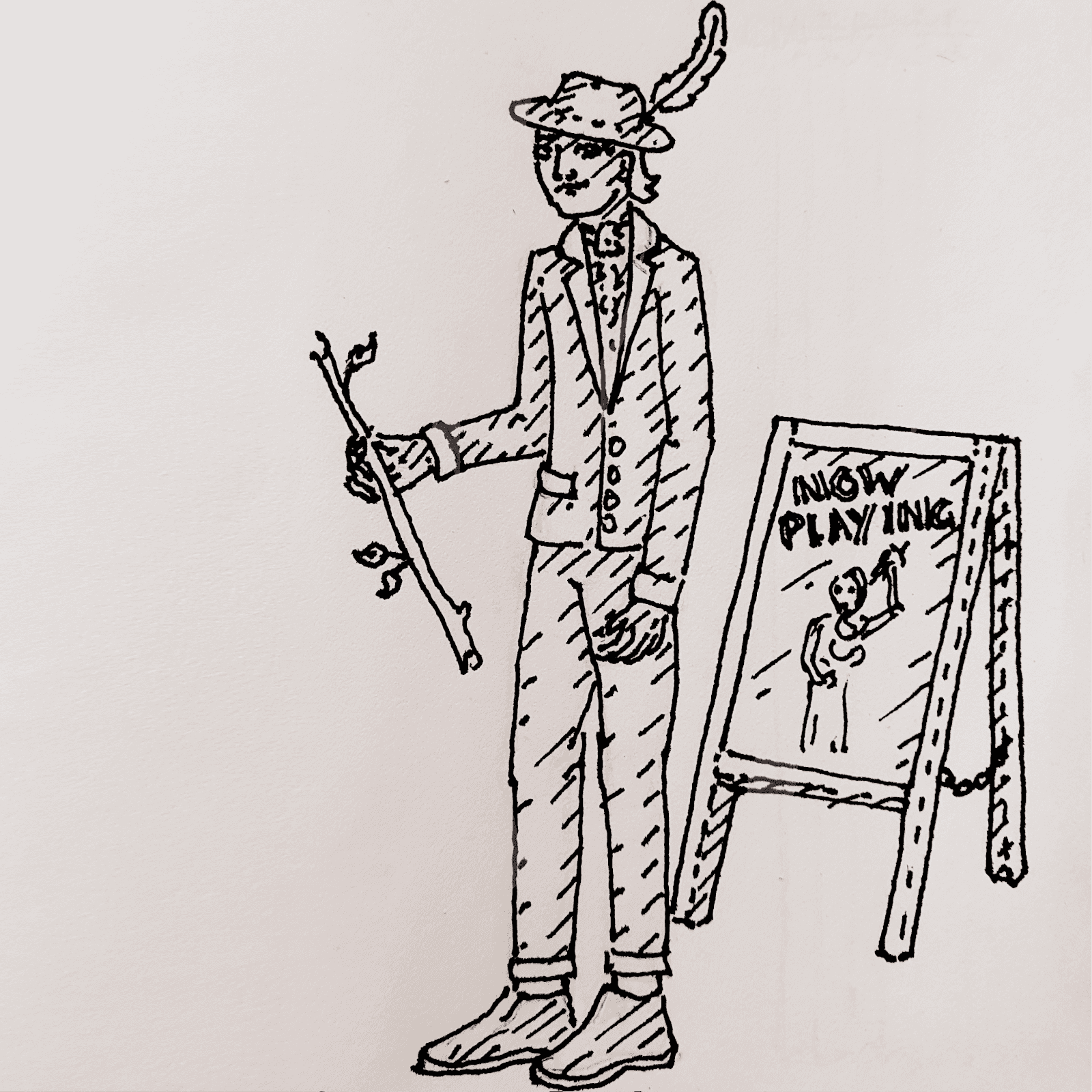
Theatre, Darling!
October 25, 2026Many instinctively understand that all they experience in society is theatre — I will be looking at what that means exactly, at various layers of abstraction.
A Fool's Journey
Within a fostered map of the world that is found to be crumbling down, we look to others, to see if they too are seeing and experiencing what we are, and more importantly, to look for individuals with more sovereignty and agency, who are able to act in ways we cannot. When there is seemingly no-one available to look to, we may muse upon the symbolism of the Tarot Devil card, until it is internalised that there is nothing substantive holding us back from, at least, making a start at setting out on a fool's journey, aspiring to make material ripples in the world, to make it more like the world we wish to see. Perhaps seeking to start a sustainable business adventure, or an active group.
The challenge of walking the balanced path between grafting and not getting ground down, and thereby staying on target and not having one's passion extinguished, is embraced, knowing well that it is a high aim, but that it is a noble undertaking, nonetheless. It may be seen that the endeavour has no hope of paying out, as the world conspires against you, but what are you going to do instead? Feel hopeless, be angry? Cuck yourself from the masculine spirit?
They
The use of theatre as a metaphor means we must address who the stage managers could be, and thus, who is being referenced by the use of "they" as a proper noun:
"... they want it all ... they got it all ..." ~ Combichrist
Hu-man language is not a structured language. Hu-man language relies on context and nuances that can be left out, because hu-men are intelligent enough to fill in nuances appropriately. When people talk of elites controlling society, I can understand what they mean, even though the statement has nuances to it and is missing context.
Obviously, there are elites, or an alpha class; this is true due to the first-past-the-post law, the natural law of 'possession is 9/10ths of the law' (it's hard to take stuff from someone who has stuff). In the same way that you can argue that modern society is all performative theatre, you can argue that there is no decision-making elite staging the theatre.
The ideas pursued rely on 3 main axioms:
- A pack being:
Man is a pack being, in the main, not a herd or a solitary being. Man being a herd animal is tied up with the mythology of democracy. This is a seemingly obvious point, yet is rarely discussed, because of the ugliness associated with it. Think of high school, how the goths would not hang with the preppy kids, and how the poor, tough kids would hang with each other. Now think of adult society, and don't kid yourself. Police go to their own community events, and socialise with their own; military personnel, journalists, politicians, artists, too. The reason for this, again, is obvious: they are sticking to the people that they have the most in common with and are most in contact with. So, in society, we have a vast array of different classes and sub-classes that, in the main, stick to their own.
- Reinforcement learning:
A reasonable model for behaviour in the real world is that of an agent in reinforcement learning. An agent in an action space seeking to pursue reward will take the action with the lowest risk, regardless of what that action is.
- Hu-men cannot govern complexity
Hu-men can only steer complexity like a sheepdog plays with a herd. The context window limits both man and machine from ever being able to fully control complexity.
Cyclical history
I fundamentally reject the popularised notion of cyclical history. Of course, there is a flow and ebb to complex systems, but the popular notion of cyclical history is fundamentally wrong because it is focused at the wrong level of abstraction.
Millennial snowflake drama
As a millennial (the 5th generation after WWII, 4th after Bretton Woods #1), my experience of Western society has been rug pull after rug pull.
- We were told higher education gives upward mobility, only for it to change into a debt trap, of marginal benefit.
- A financial crash permanently stunted economic activity.
- Jobs dried up as older generations clung on to them and pre-trained individuals were imported.
- Housing became unattainable.
- A career in software development turned into a constant race to the bottom.
- Seasonal elf-shot was sensationalised as cover for a banking crisis and planned restructuring of society.
Older millennials and GenXers got their start before opportunities evaporated, and younger generations never even perceived the paths as being viable, which were marketed to the older generations. None of this is due to strong men or weak men. I was born in the bear cycle of the USA Usurious Government Guilt sales. It is that simple. I have nothing but respect for peers and younger generations that are managing to get by.
To believe in strong men and weak men is to believe in emergent power, a belief that is as silly as democracy, and not worth more comment. People are not equal; some have resources, access to resources and connections, some have better genetics and some have gnosis, all of which facilitate first-past-the-post, or the commandeering of resources, that then enables positions to be consolidated.
The abstraction to look at in terms of societal cycles is that of the underlying arbitrage / or fraud that is sustaining the core of the society. The current fraud sustaining society is USA Usurious Guilt sales.
tl;dr;
- Governments auction contracts of guilt to hold capital for a fixed term in return for a percentage return payout.
- Governments want the payout to be as low as possible, but to attract sales they may have to raise the payout percentage.
- The attractiveness of the contract depends on the strength of the currency.
- If the currency is sound, then a return percentage in the stated currency over the term of the contract that locks up the capital is a good deal.
- If the currency is poor, then a return percentage in the stated currency over the term of the contract that locks up the capital may not be a good deal.
- A country's currency is healthy if there is a lively economy and the government can skim its take from the economic activity to pay its obligations.
- If a country has a stalling economy and it is struggling to skim enough off the economic activity to meet its obligations, it will have to make up money to pay its obligations, which in turn makes future attempted sales of government guilt contracts harder, as the market sees what they are doing from economic metrics and valuations of the currency.
Those with direct access to the capital that gets locked up in the guilt contracts enjoy the high life, which creates an obfuscated form of loosh harvesting, via an exchange of tokenised usury tokens, with just enough complication that it cannot be called out for what it is to a person who has not himself mapped out the workings of the system. As a metaphor for this loosh harvesting, my mind goes to the rowboat galleons of antiquity, where people on the deck enjoy the ride, while slaves get dragged below deck to row until they are spent. Of course, when the actual sovereign components of society are not correctly perceived, then all wrongly identified decision-making procedures are all theatre. The cycle of society is ultimately the verve of the fraud or arbitrage that sustains it. In documented history, there have been a few:
- slave trade
- coin clipping
- fractional reserve bookkeeping
- paper-backed usury token auctions
Thinking to the future, a possible new fraud to base society around could be the maintenance of complicated systems. People can be loosh harvested via the constant required maintenance of complicated systems, while a class of people gets to enjoy the utility and rewards of the complicated systems working. The Egyptians built their societal fraud around reverence of death, by contrast a technological system would, in effect, be built around the reverence of the now. A better mental model than that of an elite class staging theatre for the masses is that of a priest class, who are in service to a fraud or arbitrage (a cybernetic form that was godded into being), and any theatre is merely an emergent manifestation of the lies "They" tell to themselves, to convince themselves they are sovereign rather than the godded entity. To give themselves meaning, "They" will conjure, pick out and promote mythology that supports them having their position.
Cybernetics
"Secrets of Secrets" — a manuscript that was in circulation in the 14C details how good governance stems from the interdependence of different domains of society, which is a systems-thinking approach to societal governance. Each of the domains of such a societal system exists within an open system, with only the other domains and the frontier acting as their hard boundaries. One domain's zeal can lead to dominance, causing other domains to recede.
A rational agent leading a particular domain will come to learn, in the context of the time and environment, what actions are needed to defend their domain, and what actions are needed to expand the domain. These learned behaviours, in short, create a dampening system that resists disruption to each of the domains that make up the whole. As long as the actions learnt remain relevant, the overall state of the system can remain relatively unchanged. As a result, observed behaviour can reasonably be labelled as theatre, like a boring game of chess — "... oh, you moved there, so I must move here."
This boring state — (poetically, it is a death, or the extinguishing of the Odynic flame) — in which all is theatre, is the state the Freemason Albert Pike reveals as being actively pursued in the opening to "Morals and Dogma", in which structures on earth are to be created to reflect the laws of heaven (as perceived by the "enlightened").
This state will only remain as long as learned behaviours remain relevant. Action itself will change the relevance of the action over time; due to arbitrage, degradation, and anti-brittle systems, learned actions do not remain relevant indefinitely. Actions required will eventually have to change to such a degree that they can be said to no longer even rhyme with the previous actions. The system reorganises completely at this point, and as it does, new boundary lines between the domains of the system will be formed. Perhaps new domains will be born and old ones destroyed. Different ages have distinct flavours as a consequence of this.
Godding
When you attempt to think at a systems level of society, it is hubris to have the belief that hu-men have agency. Hu-men acting in a system domain that is beyond their sphere of influence can only ever god a daemon or a God, in the hope of affecting the macro system layer in desired ways. Most of the time, this will take the form of cathartic prayer, but other times it could be narrative seeding, or with AI accelerationism and the push for machine manufacturing that came before, it is more like a literal attempt to god a God or a daemon.
Grifting
Performative action is practice or play, but when people depend on a particular action to sustain their lifestyle, and performative action is not possible, the only other option is predatory — the "grift".
A policeman being told he needs to meet his target by some software package, an being unable to perform his authentic role, has no option but to turn to a predatory grift. He must seek out people doing minor infractions, facilitated by the bloated Catholic-born canon of law, to tick a box and make his mortgage payment without the software package poorly grading him. The policeman must grift, with the pack he makes up with his colleagues.
In a lecture, Manly P. Hall spoke of how hu-manity's big challenge is to learn how to turn in on itself, as there are now no new lands that can be turned to escape the pressures and problems of home ... well, it turned out humanity learnt how to turn in on itself and craft grifting into fine skill. Pharmaceutical companies market poo and vomit samples, monkey liver cells ... within injection vials for children so that they can make a salary, knowing that the deaths and legal comebacks that will result from their actions will not hurt their bottom line. Similar, happens across the board. This is what humanity turning in on itself looks like in practice. Loosh harvesting.
Grifting is fake theatrical action, ultimately demanded by the fraud / arbitrage of the age. People need to be harvested of loosh, and with no other viable option, they must grift. It is possible, however, that some grifts can have positive aspects, as culture can be born of the ashes of a good grift. The masses that live in the shadow of a castle or church attach themselves to the architecture and heraldic imagery that they live in the shadow of. And why wouldn't they? Ultimately, it is a dance that is perpetuated by those with the assets to push a dance into taking place.
Conclusion
At a societal level, it is all theatre, whether by that you mean literal theatre, in which leaders and CEOs are former film and TV stars, or where leaders and figureheads are an assortment of body doubles that have undergone intense lessons in acting, or whether a leader is a rational agent, but lacks sufficient sovereignty to actually make any meaningful decisions or take any meaningful actions. When your mental model of the mechanics of the functioning of society does not sufficiently reflect the actual functioning of society, actions look like theatre.
At a more objective level, in a low-entropy environment, theatre is inevitable due to the lack of viable actions, such that agents in an action space have their choice of action made for them. A crowded action space, also makes intra-action safer than frontier action, which leads to the concept of loosh harvesting, where groups prey on unsuspecting others through grifts and fraud.
Even at the level of individuals that have sovereignty to act, there is again theatre, for a hu-man cannot control complexity. If you desire to change or have influence on that which is beyond your agency, what option do you have but to god a spirit, daemon or God to try to bring forth desirable changes? One must remember the realm of the Gods is the realm of the Gods, and so do not have the hubris to think you can seed a complex system to bring about desired outcomes. Developers spend lives struggling with this reality — [biochemists, virologists simply lie and LARP that they can manage complexity]. Hard problems are hard. If hard problems were made easy via fairy-dust magic, the whole of reality collapses.